
For organizations that rely on shared mobile devices, keeping batteries charged is important. But charging is only one part of keeping a device fleet ready for work.
Whether mobile devices are being used in healthcare, retail, hospitality, education, warehousing or other enterprise environments, shared-device programs create a larger operational challenge: devices need to be collected, organized, charged, stored and made ready for the next employee or shift.
Without a defined workflow, even a fully charged device can still be difficult to find, improperly stored or unavailable when someone needs it.
That is why effective shared device management needs to go beyond charging.
Start With the Full Device Journey
A shared device may move through multiple employees, departments and locations during a single day.
At the beginning of a shift, employees need to quickly locate a ready device. Throughout the day, devices may move throughout a facility. At the end of the shift, they need to return to a designated location where they can be organized, connected to power and prepared for their next use.
When that process is informal, small inefficiencies can add up.
Employees may spend time searching for devices. Cables can become tangled or disconnected. Devices may be returned to different locations. Some may charge while others are overlooked entirely.
A successful workflow creates a predictable cycle:
Deploy. Use. Return. Charge. Organize. Repeat.
The simpler and more consistent that cycle becomes, the easier it is for teams to keep shared technology available.
Create a Defined Home for Shared Devices
One of the simplest improvements organizations can make is establishing a dedicated location for shared devices.
Instead of leaving devices on counters, in drawers or connected to individual wall chargers throughout a workspace, a centralized device management station gives employees a clear place to retrieve and return equipment.
This becomes especially valuable when organizations manage multiple device types.
Many workplaces no longer operate standardized fleets consisting of one identical handheld or mobile computer. Different teams may use different manufacturers, models and accessories depending on the application.
A flexible charging and storage system can help bring those devices together into one organized workflow rather than creating separate charging areas for every device type.
Make Device Status Easy to See
Employees should not have to unplug a device or inspect it individually to determine whether it is ready.
Visibility matters.
A well-designed charging system makes it easy to see which devices are connected and charging so employees can quickly identify equipment that is ready for use.
This becomes especially important during shift changes or high-volume periods, when dozens of employees may need access to devices within a short period of time.
The goal is not simply to charge the fleet.
It is to make device readiness obvious.
Reduce Cable and Workspace Clutter
Shared-device environments often accumulate cables quickly.
Different connectors, adapters and power supplies can turn an otherwise organized workspace into a collection of loose cords and chargers.
Cable management should therefore be considered part of the device workflow itself.
Organizing cables within a centralized charging solution can help create a cleaner workspace while also making it easier for employees to correctly reconnect devices when they are returned.
That consistency helps reduce one of the most common problems with shared-device charging: a device that appears to have been returned correctly but was never actually connected to power.
Build the Workflow Around Employees
The most effective device management processes are usually the simplest ones.
Employees should not need extensive instructions to understand where a device belongs or how it should be returned.
Ideally, the workflow should be intuitive:
Take a device at the beginning of the shift. Use it throughout the day. Return it to the same location when finished. Connect it to power. Allow the system to prepare it for the next user.
When a process is easy to follow, employees are more likely to follow it consistently.
Plan for Change
Mobile technology changes quickly.
Organizations replace devices, introduce new models and expand their fleets over time. A charging environment built around one specific device can become difficult to maintain when hardware changes.
That is why flexibility should be considered when designing a shared-device workflow.
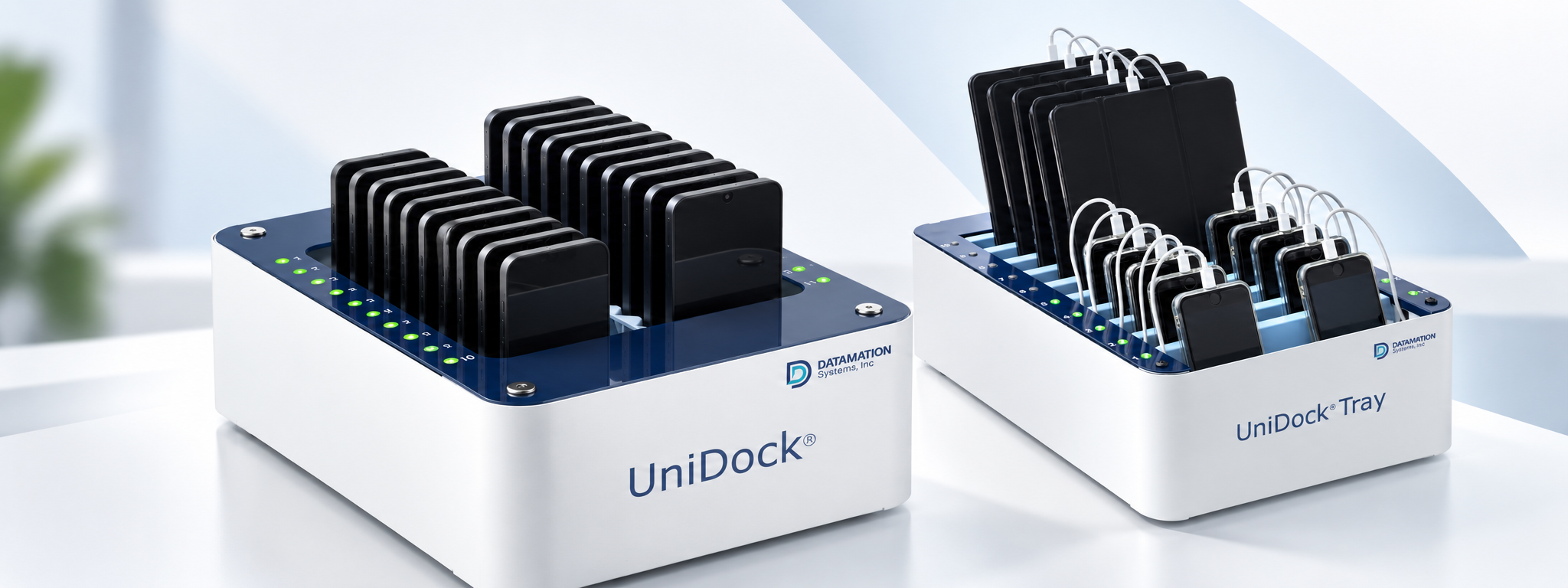
Datamation Systems’ UniDock intelligent charging solutions are designed to support mixed fleets of mobile devices within a centralized charging environment. Configurable trays, organized cable management and highly visible charging indicators help organizations create a repeatable process for keeping devices organized and ready for use.
As devices change, the workflow does not necessarily have to.
Charging Is the Beginning, Not the Entire Solution
The goal of shared device management is not simply to put power into a battery.
It is to make sure the right device is available, organized and ready when an employee needs it.
By thinking about the complete device journey — from deployment through return and recharge — organizations can create a more efficient and predictable shared-device environment.
Because when mobile technology is essential to the workday, device readiness should never be left to chance.